

Electricity is often discussed in terms of units consumed, bills generated, or sanctioned load. For industry, power is far more than a number on a meter. It affects production continuity, equipment performance, operating cost, expansion planning, safety, and delivery commitments. That is why industrial power management belongs in business strategy, not only in the electrical department.
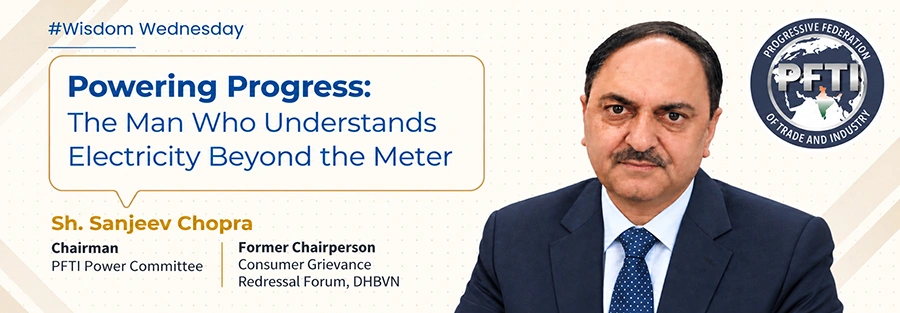
At PFTI, this wider perspective is represented by Sh. Sanjeev Kumar Chopra, Chairman of the Power Committee and Director of Saneasia Power Utilities Pvt. Ltd. PFTI also identifies him as a former Chairperson of the Consumer Grievance Redressal Forum, DHBVN. His experience connects consumer concerns, utility processes, and the practical requirements of industry. This makes industrial power management a conversation about reliability, accountability, infrastructure, and growth.
Why Industrial Power Management Goes Beyond the Meter
A meter records consumption, but it does not explain whether poor power quality is affecting machinery, whether interruptions are delaying production, or whether future expansion can be supported by the existing electrical system.
Industrial power management looks at the wider relationship between a business and its electricity infrastructure. It includes supply reliability, power quality, capacity planning, service issues, and the financial impact of power-related decisions.
For manufacturing units, even a short disruption can affect machines, manpower, quality, and dispatch schedules. That makes industrial power management a direct business concern.
Sanjeev Chopra and Industrial Power Management
PFTI’s published profile of Sh. Sanjeev Kumar Chopra highlights his leadership of the Power Committee and his former role with the Consumer Grievance Redressal Forum of DHBVN.
This background is relevant to industrial power management because businesses often need someone who understands both operational concerns and the processes through which consumer issues are addressed.
His role is not simply about tariffs or meter readings. Industrial power management requires understanding where business operations meet distribution systems, service obligations, infrastructure limitations, and consumer expectations.
Readers can learn more about PFTI’s leadership on the PFTI Team page.
Industrial Power Management and Business Continuity
Power reliability is directly linked with operational continuity. When supply becomes unstable, the cost is rarely limited to the electricity bill.
Production lines may stop, automated systems may reset, batches may require rework, and delivery schedules may slip. Industrial power management therefore includes understanding the operational cost of interruptions and preparing the business to respond.
As factories adopt automation, robotics, connected systems, and digital controls, their dependence on stable electricity increases. Industrial power management helps leadership treat reliability as a business risk rather than a routine utility matter.
Why India Needs Better Industrial Power Management
India’s electricity demand is rising alongside industrial activity, digital infrastructure, cooling demand, and electrification. Reuters reported in October 2026 that India experienced its highest power shortages in more than three years during September, despite higher coal-fired generation, with stronger industrial activity contributing to demand pressure.
This context makes industrial power management increasingly important for businesses that depend on uninterrupted operations. Read the Reuters report on India’s power shortfall.
A growing economy needs more generation, but industrial power management also depends on transmission, distribution, local infrastructure, demand planning, and effective coordination between users and utilities.
Industrial Power Management Starts With Understanding Your Load
Many businesses know their electricity bill but do not study how and when their electrical load changes.
Industrial power management begins with basic questions. What is the peak load? Which processes drive it? Are machines starting at the same time? Is the sanctioned load aligned with current and future requirements?
Understanding the load profile helps businesses identify operational risks. Industrial power management becomes more useful when electricity data is connected with production data. Higher consumption may reflect increased output, or it may reveal inefficiency, equipment deterioration, or poor operating discipline.
Power Quality Is Part of Industrial Power Management
Electricity availability is only one part of the picture. The quality of the supply can also affect industrial equipment.
Voltage fluctuations, harmonics, poor power factor, and other electrical disturbances can create operational problems depending on the equipment and process involved.
Industrial power management therefore requires businesses to look beyond whether electricity is simply available. Readers wanting basic background on the wider system can review Wikipedia’s overview of the electrical grid.
Industrial Power Management and Cost Control
Electricity can represent a major operating cost, especially for energy-intensive industries. Yet cost control should not be reduced to switching equipment off wherever possible.
Industrial power management asks whether electricity is being used productively. A machine that uses less power but creates more defects may not be saving money. Equipment operating at inefficient loads can also increase the cost per unit of production.
Businesses should connect electricity data with output, downtime, quality, and maintenance. Industrial power management becomes commercially useful when management understands the cost of power per unit of useful production.
The Human Side of Industrial Power Management
Power systems are technical, but many power-related problems are managed by people. Operators start machines, maintenance teams respond to faults, finance teams review bills, management approves upgrades, and utilities handle service requests.
Industrial power management improves when these functions communicate instead of working separately.
Industrial power management therefore requires technical understanding, communication, documentation, and follow-through.
How PFTI Supports Industrial Power Management Dialogue
PFTI’s Power Committee provides a platform for discussing electricity and power-sector concerns affecting businesses.
Industrial power management benefits from this kind of platform because many challenges are not unique to a single factory. Businesses in one industrial area may face similar concerns related to billing, infrastructure, supply quality, connectivity, or future capacity.
PFTI’s broader approach includes representation, research, knowledge sharing, and stakeholder engagement. Businesses can explore these areas on the PFTI Services page.
A stronger industrial power management dialogue can help recurring concerns become visible at industry level.
Industrial Power Management and Renewable Energy
The power system is changing as renewable energy, storage, electric mobility, and new forms of demand become more important.
Industrial power management may increasingly involve rooftop solar, open-access procurement, storage, demand response, or changes in the timing of electricity use. The right option depends on regulation, location, load profile, economics, and operational needs.
Businesses should avoid treating every new technology as automatically suitable. industrial energy management requires evaluating whether a solution fits the actual operating pattern of the factory.
industrial energy management Requires Better Data
A monthly bill gives only a limited view of what happens inside a factory.
industrial energy management improves when businesses monitor demand patterns, major electrical loads, power factor, downtime linked with supply issues, and energy consumed by important processes.
Depending on the operation, sub-metering and digital monitoring can reveal problems that total consumption hides. industrial energy management works best when management assigns responsibility for acting on what the data shows.
industrial energy management and Future Expansion
Power planning should begin before a new machine arrives.
A factory planning additional production lines, automation, electric heating, cooling, or other major equipment needs to know whether existing electrical infrastructure can support the expansion.
industrial energy management should therefore be included in capital planning. Ignoring electricity requirements until installation can create delays, connection issues, infrastructure upgrades, or unexpected costs.
industrial energy management helps businesses consider supply capacity, internal distribution, safety, backup arrangements, and future demand before expansion decisions are finalised.
Why industrial energy management Needs Industry Representation
One company can raise its own service issue, but some power challenges affect entire industrial areas.
industrial energy management becomes more effective when individual cases are documented and recurring patterns are identified. Industry bodies can then bring a broader perspective to discussions with relevant stakeholders.
Representation should remain evidence-based. industrial energy management becomes a stronger industry agenda when businesses contribute accurate information about how power-related issues affect production, investment, and competitiveness.
The Leadership Lesson Behind industrial energy management
The phrase “beyond the meter” captures an important leadership idea: the visible number is rarely the whole story.
industrial energy management requires leaders to look at the system behind the bill – infrastructure, service quality, internal efficiency, future demand, communication, and risk.
Sh. Sanjeev Kumar Chopra’s role at PFTI reflects this broader approach. His experience across consumer grievance redressal and the power sector supports a conversation that connects electricity with practical industry realities.
industrial energy management is ultimately about helping businesses operate with greater clarity, reliability, and preparedness.
Conclusion: Powering Progress Beyond the Meter
Electricity powers machines, but dependable electricity also supports productivity, customer commitments, investment confidence, and growth.
industrial energy management helps businesses understand this wider relationship. It encourages manufacturers to study reliability, quality, load patterns, cost, internal systems, future requirements, and the processes through which power-related concerns are addressed.
As India’s demand grows and the electricity system evolves, industrial energy management will become even more important for companies trying to remain competitive.
The strongest approach is not to think about electricity only when the bill arrives or the supply fails. It is to treat power as strategic infrastructure.
That is what it means to understand electricity beyond the meter: seeing not just consumption, but the connection between power, productivity, resilience, and progress.