

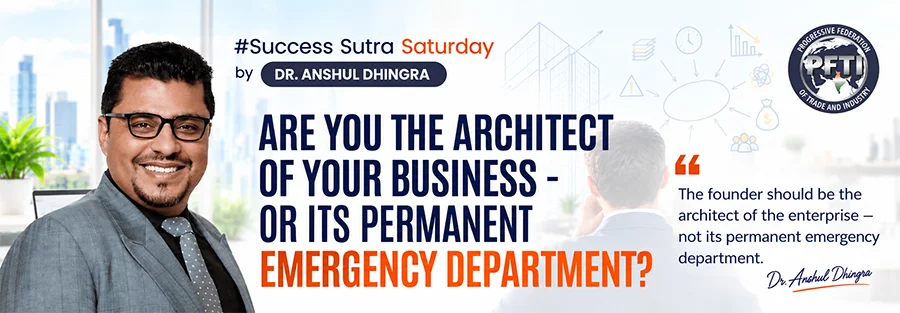
That is the point where founder dependency starts limiting growth.
Reducing founder dependency is therefore not about stepping away from responsibility.
Why Founder Dependency Becomes a Growth Problem
Founder dependency often develops gradually. Customers insist on speaking directly with the founder.
Founder dependency slows decisions, creates queues around senior leadership, and prevents capable people from developing judgement.
Founder Dependency Turns the Leader Into a Bottleneck
Founder dependency becomes visible when decisions accumulate during the founder’s absence or when teams repeatedly say, “We need to ask sir or ma’am first.
The problem is that founder dependency makes too many ordinary decisions important simply because authority has never been distributed.
Founder Dependency Often Hides Behind Commitment
These are valuable instincts.
Founder dependency can therefore look like dedication from the outside while creating weakness inside.
Reducing founder dependency means using repeated emergencies as information about what needs to be redesigned.
Founder Dependency Is Reduced by Clear Decision Rights
A manager may be responsible for customer service but still need approval for every replacement. A purchase head may be accountable for suppliers but unable to approve a routine order. In such cases, responsibility exists without decision rights.
Founder dependency reduces when teams know what they can decide, what limits apply, and when escalation is necessary.
Clear decision rights should define thresholds for spending, discounts, hiring, quality exceptions, customer remedies, and operational changes.
This creates faster action without removing control. It also helps founder dependency decrease because employees can solve normal problems at the appropriate level.
Strong Processes Help Reduce Founder Dependency
Systems make good performance repeatable.
Business process management is built around identifying, documenting, measuring, controlling, and improving workflows so that organisational goals can be achieved consistently. Readers can review the broader concept in Wikipedia’s overview of business process management.
Founder dependency is difficult to reduce when critical work exists only in someone’s memory.
Processes do not need to become bureaucratic manuals. A useful process may be a checklist, approval matrix, standard quotation template, escalation rule, dashboard, or defined handoff between departments.
The goal is simple: important work should happen because the system supports it, not because the founder remembered to intervene.
Founder Dependency Requires Better Managers, Not More Assistants
One common response to overload is hiring people to support the founder.
That may improve scheduling, coordination, and communication, but founder dependency remains if every meaningful decision still returns to the same desk.
A growing organisation needs managers who own outcomes, not only assistants who move information upward.
Managers need context, authority, targets, and consequences. They also need room to make reasonable mistakes and learn from them.
Founder dependency decreases when leaders develop other leaders who can think, decide, and take responsibility within clear boundaries.
Founder Dependency Can Damage Team Ownership
Employees stop taking ownership when experience teaches them that the final answer always comes from the founder.
They may become excellent at escalating problems but weak at solving them. Over time, even capable people can become passive because initiative feels risky or unnecessary.
Founder dependency therefore affects culture as much as structure.
A healthier pattern is to ask managers for their recommendation before giving an answer. What do they think should happen? What evidence supports it? What risk are they considering?
This approach gradually builds judgement. Founder dependency reduces when the team becomes accountable for thinking, not only reporting.
Founder Dependency Makes Succession Harder
A business becomes more valuable when leadership continuity is built into the organisation.
Recent leadership transitions in large companies show how seriously markets treat succession and operating structure. Reuters reported in October 2026 that HDFC Bank’s appointment of an external chief executive was viewed positively by analysts partly because of expectations around governance, management stability, and future operating priorities. Read the Reuters report.
Founder dependency creates the opposite condition: key relationships, knowledge, and decisions remain concentrated in one person.
Even family-owned and promoter-led businesses benefit from asking how leadership would continue during illness, travel, retirement, or an unexpected event.
Overdependence on the Founder Can Be Measured
A company does not need a complicated consulting project to understand whether dependence is excessive.
Track the number of decisions that require founder approval during one week. Review how many could reasonably be handled by trained managers under defined limits. Examine what stops when the founder is unavailable for one day.
Overdependence on the founder can also be measured through recurring questions, approval delays, customer escalations, and decisions that have no documented owner.
The objective is not to eliminate the founder from the business. It is to identify where the founder is adding unique value and where the organisation is using the founder as a substitute for missing structure.
Overdependence on the Founder Should Be Replaced With Management Rhythm
A business needs regular mechanisms for communication and control.
Daily operational reviews, weekly functional meetings, monthly performance reviews, dashboards, exception reports, and clear targets can reduce the need for constant informal checking.
Overdependence on the founder often grows because leaders do not trust the information reaching them. They intervene because reports are late, inconsistent, or incomplete.
A reliable management rhythm creates visibility without micromanagement.
When the founder can see performance through agreed measures and scheduled reviews, there is less need to chase every issue personally. overdependence on the founder begins to fall because control moves from constant presence to reliable information.
PFTI Can Support Thinking Beyond Overdependence on the Founder
Growing a business requires more than solving today’s problems. It requires exposure to better practices, stronger networks, experienced professionals, and ideas that help leaders see their organisations differently.
PFTI’s Knowledge Hub focuses on industry insights, studies, peer learning, and practical knowledge. Its Services platform also includes mentoring, research, networking, publications, and business support.
These resources can help business leaders step outside daily firefighting and think about management capability, systems, markets, and long-term growth.
Overdependence on the founder is ultimately an internal leadership challenge, but external learning can help founders recognise patterns they have become too close to notice.
How to Start Reducing Overdependence on the Founder
The best place to begin is not by disappearing from the business for a month.
Choose one recurring category of decisions and redesign it. Define the owner, decision limit, information required, and escalation rule. Let the responsible manager operate within those boundaries and review outcomes afterward.
Then repeat the process in another area.
Overdependence on the founder is usually created over years, so it should be reduced deliberately rather than dramatically.
Document critical knowledge, strengthen second-line leaders, standardise recurring work, and build reporting that gives the founder confidence without requiring constant intervention.
Small structural changes can eventually transform the founder’s role from chief problem-solver to enterprise architect.
Conclusion: Replace Overdependence on the Founder With Organisational Capability
A founder should remain important to the business. The goal is not to make leadership irrelevant.
The goal is to make the organisation capable.
Overdependence on the founder becomes dangerous when the company cannot make ordinary decisions, maintain customer service, or solve recurring problems without one person stepping in.
An architect designs structures that continue working after the drawing is complete. Business leadership requires the same mindset.
Build people who can decide. Build processes that make expectations clear. Build information systems that create visibility. Build managers who own outcomes. Build a culture where problems are solved at the right level.
Reducing overdependence on the founder does not weaken the founder’s influence. It moves that influence from daily rescue into the systems, standards, people, and priorities that shape the organisation.
The real test of leadership is not how many emergencies you can personally solve.
It is whether you can build a business that creates fewer emergencies and handles the rest without needing you at the centre of every one.