
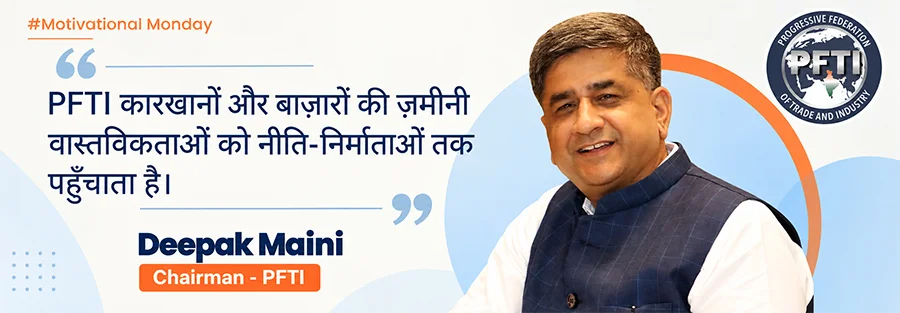
Policies are often designed at a level where the larger objective is clear: improve compliance, strengthen competitiveness, protect workers, modernise industry, increase exports, or support investment. Yet the real test begins when those policies reach factory floors, warehouses, offices, markets, supply chains, and small businesses. This is where industry policy representation becomes essential.
PFTI’s role is to help connect policy intent with operational reality. Manufacturers, traders, MSMEs, service providers, and entrepreneurs often understand the practical impact of rules before that impact becomes visible in formal reports. industry policy representation creates a structured route through which those experiences can be documented, organised, and brought to the policymakers and institutions responsible for implementation.
Why Industry Policy Representation Starts With Ground Reality
industry policy representation begins by listening to what businesses actually experience when a new rule, procedure, digital system, standard, tax requirement, labour obligation, or market restriction is implemented.
Industry Policy Representation Turns Individual Problems Into Shared Industry Issues
industry policy representation helps identify these patterns.
PFTI’s article PFTI Takes the Realities of Factories and Markets to the Tables Where Policies Are Shaped explains why business experience matters when wider policy conversations are taking place.
Industry Policy Representation Requires Clear Evidence
industry policy representation becomes more credible when concerns are supported by evidence.
Industry Policy Representation Connects Policy Objectives With Implementation Reality
industry policy representation works best when it recognises that objective rather than treating government and industry as opposing sides.
PFTI Services Support Industry Policy Representation
The PFTI Services page identifies Policy Advocacy & Representation and Research & Industry Insights among the federation’s core services.
These functions are closely connected with industry policy representation.
It should begin with understanding.
Industry Policy Representation Needs the Right Stakeholder
industry policy representation requires understanding who has authority over the specific problem.
Industry Policy Representation Benefits From Industry Policy Dialogue
industry policy representation is more effective when it creates a dialogue between businesses and the institutions responsible for policy and implementation.
PFTI’s article Industry Policy Dialogue explains how structured discussion can move industry concerns toward clarification, practical solutions, and follow-through.
Industry Policy Representation Can Improve Regulatory Clarity
industry policy representation may reveal that businesses are struggling because guidance is unclear, different offices are interpreting the same requirement differently, or implementation details are missing.
This distinction matters.
Industry Policy Representation Can Help Policymakers See MSME Impact
industry policy representation becomes especially important for MSMEs because smaller enterprises may experience the same policy with fewer internal resources.
Industry Policy Representation Should Include Market Reality, Not Only Factory Reality
Policy affects more than production.
industry policy representation should also capture what is happening in markets.
Similarly, a compliance requirement may affect not only factories but distributors, dealers, retailers, and service providers.
Representation becomes more complete when the full commercial chain is considered.
Industry Policy Representation Helps Industry Respond to New Regulatory Proposals
Consultation is most useful before a proposal becomes difficult to change.
industry policy representation allows industry bodies to bring practical feedback into the discussion while new rules are still being considered.
Reuters reported in October 2026 that India’s insurance brokers opposed proposed regulatory reforms, arguing that commission caps could affect revenues and employment, and sought a longer consultation period and impact assessment. Read the Reuters report.
The example shows why organised industry feedback matters.
It gives regulators access to sector-specific consequences that may not be visible from the policy proposal alone.
Industry Policy Representation Should Not Become Permanent Opposition
A trade body loses credibility if it opposes every new regulation automatically.
industry policy representation requires judgement.
Some policies may strengthen transparency, safety, competition, sustainability, or consumer protection. Industry may support the objective while asking for changes to the implementation process.
A responsible federation should be willing to say when a reform is useful.
It should also be willing to present evidence when a provision creates unintended consequences.
Balanced representation is more valuable than predictable opposition.
Industry Policy Representation Depends on Responsible Member Participation
PFTI cannot represent realities that members do not share.
industry policy representation becomes stronger when businesses provide accurate information, examples, documents, timelines, and technical details.
Members should also distinguish between a private commercial dispute and a wider industry issue.
A disagreement with one customer or supplier may require a different solution from a recurring policy or regulatory problem.
Responsible participation helps the federation focus its resources on issues where collective representation can create genuine value.
PFTI Membership Strengthens Industry Policy Representation
The PFTI Membership page highlights policy advocacy, government liaison, market intelligence, committee participation, networking, and business support.
These features can strengthen industry policy representation because representation improves when members participate regularly rather than only during a crisis.
Committees can identify recurring issues. Members can compare experiences. Subject specialists can test assumptions. Industry leaders can help define practical recommendations.
The federation becomes more useful when member input is continuous and organised.
A strong collective voice is built over time.
Policy Engagement Process Benefits From Technical Expertise
Many policy issues are highly specialised.
Policy Engagement Process becomes more effective when technical experts are involved before a position is finalised.
Environmental compliance, taxation, engineering standards, labour regulation, exports, finance, and energy each require different knowledge.
A technical committee can identify whether the business concern is being described accurately.
Experts can also help ensure that the proposed solution is workable.
This reduces the risk of presenting a recommendation that sounds attractive but creates new problems elsewhere.
Policy Engagement Process Helps Policymakers Understand Unintended Consequences
Rules can produce effects that were not predicted during policy design.
Policy Engagement Process creates a mechanism for those effects to be reported.
Reuters reported in September 2026 that Indian tax authorities accused major appliance companies of failing to detect fabricated e-waste recycling claims made by an authorised recycler, prompting wider concern across the electronics industry about verification and compliance systems. Read the Reuters report.
The case highlights how implementation can reveal risks that require stronger controls, clearer responsibilities, and better verification.
Ground-level experience can help policy systems evolve.
Policy Engagement Process Should Include Practical Recommendations
Representation is more useful when it goes beyond describing the problem.
Policy Engagement Process should include practical options.
These might involve clearer guidance, revised timelines, better digital processes, standardised interpretations, phased implementation, technical clarification, simpler documentation, or stronger coordination between departments.
A recommendation should explain why it helps both the policy objective and the businesses implementing the rule.
Constructive solutions make it easier for policymakers to evaluate the request.
They also show that industry is participating responsibly.
Policy Engagement Process Needs Follow-Through
A meeting or memorandum is not the end of the process.
Policy Engagement Process should include a system for tracking what happens after the issue is raised.
Members need to know whether the concern was acknowledged, whether further information was requested, and whether the issue remains under discussion.
Some matters may take months or longer.
Others may require legal review, technical consultation, or action by multiple institutions.
Follow-through builds trust because members can see that their input entered a real process.
Policy Engagement Process Creates Value Even When Policy Does Not Change
Not every representation will produce a new rule.
Policy Engagement Process can still create value through clarification, improved understanding, better preparedness, or more consistent implementation.
A dialogue may reveal that the existing rule already provides a solution that businesses were not aware of.
It may identify the correct authority.
It may help companies prepare systems earlier.
It may also help policymakers understand where further communication is needed.
Representation should therefore be measured by the quality of engagement as well as by formal policy change.
PFTI Can Build Credibility Through Policy Engagement Process
Credibility grows when an industry body raises the right issues, supports them with evidence, and communicates responsibly.
Policy Engagement Process gives PFTI an opportunity to become a trusted bridge between enterprises and the policy ecosystem.
That role requires discipline.
The federation should avoid exaggeration, distinguish evidence from opinion, involve relevant experts, and acknowledge when members hold different views.
Trust with policymakers is valuable because it improves the quality of future conversations.
Trust with members is equally important because businesses are more likely to share useful information when they believe it will be handled professionally.
Conclusion: Policy Engagement Process Brings Policy and Reality Closer Together
Factories and markets contain information that policy documents cannot always capture.
Policy Engagement Process gives that information a structured route into wider decision-making.
PFTI can listen to members, identify patterns, gather evidence, involve experts, define practical recommendations, and take relevant concerns to the right stakeholders.
The goal is not to promise that every business request will become policy.
The goal is to ensure that real implementation experience is part of the conversation.
When policymakers understand what is happening on the factory floor and in the market, and businesses understand the objectives behind policy, the quality of dialogue improves.
That connection can support clearer rules, better implementation, stronger competitiveness, and a more informed relationship between industry and government.