

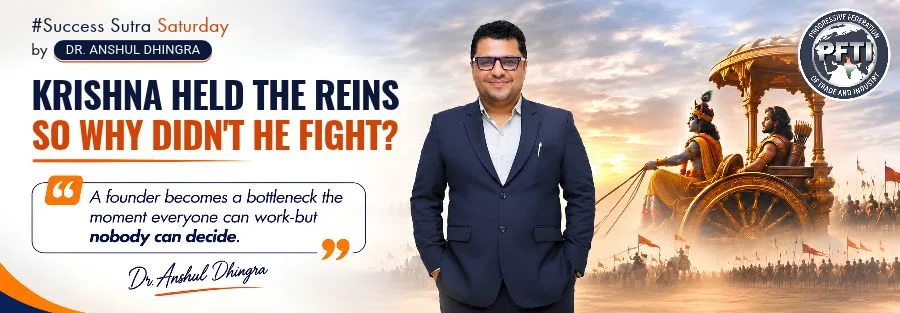
On the battlefield of Kurukshetra, one detail continues to challenge our understanding of leadership. Shri Krishna held Arjuna's reins, guided the chariot and helped him face a life-changing choice. Yet Krishna did not join the battle as an armed warrior. Why would someone with such influence accept a position that looked secondary? These Krishna leadership lessons offer more than a spiritual reflection. It opens a practical conversation about power, judgment and the responsibility of those who lead businesses, factories and institutions.
For India's industrial community, Krishna leadership lessons raise an uncomfortable question: must a leader personally fight every battle to make a meaningful contribution? In a growing enterprise, the founder cannot be the salesperson, troubleshooter, production head and final approver forever. Sometimes the highest-value work is making others capable of acting well.
Why Krishna Held the Reins Instead of Taking Up Arms
In the Mahabharata narrative, Krishna offered a choice between his support without taking up arms and his army. Arjuna chose Krishna. For Krishna leadership lessons, that choice reflected trust in judgment rather than a simple calculation of military strength. Krishna became Arjuna's charioteer, a role of close service, observation and direction. His position was not one of inactivity: he was present where decisions carried the greatest weight.
Readers can explore Krishna and his role in the Mahabharata for wider narrative context. The central leadership insight is straightforward: choosing not to wield a weapon was not the same as refusing responsibility. Krishna leadership lessons begin with the difference between doing the work and enabling the right work to happen.
Krishna Leadership Lessons: Influence Is Not the Same as Authority
A job title may give someone authority to issue instructions. Influence is earned when people trust that person's understanding, fairness and intent. Krishna had no need to prove his value by taking Arjuna's place. He contributed by helping Arjuna interpret the situation and recover his ability to choose.
Consider a manufacturer facing repeated dispatch delays. An owner might personally chase every shipment and temporarily restore order. A stronger response is to identify unclear ownership, unreliable production data or poor coordination between sales and planning. Krishna leadership lessons suggest that leaders should strengthen decisions at their source, not become the permanent emergency response team.
1. Krishna Leadership Lessons Begin With Clarity Before Action
Arjuna's crisis was not simply fear of battle. He faced a conflict involving duty, relationships and consequences. Krishna did not respond with a quick motivational slogan. The dialogue recorded in the Bhagavad Gita develops questions of action, responsibility and discernment. Its religious interpretations are diverse, but the management analogy is useful: a decision made without understanding the real dilemma can create a larger problem.
In business, clarity starts by naming the decision. Are margins falling because prices are low, rejection rates are high or cash is trapped in receivables? Those are different problems. Krishna leadership lessons encourage a disciplined pause for evidence and honest discussion before a leader demands speed.
2. Krishna Leadership Lessons Show the Strength of Empowerment
Krishna guided Arjuna but did not replace him. That distinction matters in organisations where every important decision climbs back to the founder. Employees may look busy while accountability remains concentrated in one office. When the founder travels, approvals slow. When managers hesitate, opportunities disappear.
Empowerment requires clear decision rights, competence and review. Managers need agreed limits for escalating risks. Krishna leadership lessons show how guidance can shape results without removing responsibility.
3. Krishna Leadership Lessons Demand Courageous Conversations
In Krishna leadership lessons, an effective adviser is not someone who agrees with every instinct of the decision-maker. At times, guidance means questioning assumptions, naming risks and giving uncomfortable feedback. Leaders who welcome only reassurance slowly lose access to reality. Problems then become visible only after customers complain or suppliers stop extending credit.
A business owner might be emotionally attached to an unprofitable product line. A trusted colleague should be able to show the numbers without humiliation or politics. Krishna leadership lessons highlight the value of a relationship strong enough to accommodate disagreement. Respect does not require silence; loyalty can involve telling the truth when it matters most.
4. Krishna Leadership Lessons Separate Ego From Service
The image of Krishna as a charioteer challenges the assumption that seniority must always be displayed through status. A leader may have the greatest influence while performing work that receives the least applause. In manufacturing, that could mean visiting a shop floor, listening to a trainee, resolving a safety concern or helping a team understand a change in process.
This is not a call for symbolic humility. Service becomes credible when it removes obstacles for others. Krishna leadership lessons ask whether leadership behaviour makes teams more effective or simply makes the leader more visible. Businesses can deepen this approach through structured mentoring and advisory rather than relying entirely on one person's experience.
5. Krishna Leadership Lessons Link Duty With Ethical Judgment
The Kurukshetra setting is a moral conflict, not a permission slip for aggression. The Bhagavad Gita has been understood through several philosophical traditions, and modern readers should not reduce it to a slogan about winning at any cost. In business, the appropriate lesson is to consider responsibilities alongside outcomes.
A procurement head may be able to reduce costs through a supplier who ignores safety requirements. A factory owner may be tempted to delay wages to protect short-term liquidity. Neither decision becomes sound merely because it improves a number on a dashboard. Krishna leadership lessons remind us that the method used to reach a result matters, particularly when employees, customers and communities bear the consequences.
6. Krishna Leadership Lessons Make Mentorship a Business Capability
In practice, Krishna leadership lessons challenge how mentorship is often treated as an informal favour: a senior person gives advice when asked. But growing businesses need more reliable ways of transferring judgment. First-generation entrepreneurs, family-run manufacturers and emerging managers all face decisions they may never have encountered before. Learning exclusively through mistakes can be expensive.
A useful mentoring practice starts with a real problem, asks the mentee to identify options, explores trade-offs and leaves ownership of the decision with the mentee. Krishna leadership lessons are therefore relevant to succession planning, vendor negotiations and crisis management. PFTI's discussion of business peer learning explores why the experience available across an industry network can help enterprises avoid preventable errors.
7. Krishna Leadership Lessons Turn Individual Strength Into Collective Progress
Krishna leadership lessons extend beyond individuals. A talented leader can solve a local problem. A capable network can help many organisations recognise similar problems earlier. Industrial clusters routinely face shared questions about skills, infrastructure, compliance, technology adoption and market access. Such challenges rarely disappear because one entrepreneur works harder.
Krishna leadership lessons invite leaders to shift from personal heroics to collective capability. PFTI's article on the leadership journey from factory to policy illustrates how lived experience on the factory floor can inform wider conversations. Effective industry leadership creates spaces where evidence can be shared, concerns can be represented and practical solutions can be developed collaboratively.
Applying Krishna Leadership Lessons Inside an Indian MSME
Imagine a mid-sized engineering unit that has grown quickly. The founder is still signing purchase orders, approving overtime, answering customer complaints and deciding which machine needs maintenance. Staff members admire the founder's dedication. Yet deliveries regularly slip because everyone waits for one signature. The organisation has confused constant involvement with effective leadership, the very challenge Krishna leadership lessons address.
To apply Krishna leadership lessons, first map recurring decisions. Next, identify which require the founder's judgment and which should sit with trained managers. Set measurable limits, such as approval thresholds and quality escalation triggers. Review exceptions weekly instead of interfering hourly. Finally, create space where people can report bad news early without being punished for raising it.
These practical changes put Krishna leadership lessons into motion. The founder still holds the organisation's direction, but managers learn to handle responsibility. That is not a loss of control. It is the development of a system that can operate responsibly beyond one person's immediate presence.
Why Guidance Must Not Become Control
The charioteer metaphor has limits: employees are not pieces on a battlefield. They need information, room to question instructions and freedom to raise ethical concerns. Good leaders explain decisions and make disagreement safe.
Krishna leadership lessons should therefore support independent thinking, not obedience for its own sake. A healthy enterprise measures progress through stronger judgment, safer practices, improved customer trust and a team that can act without waiting for permission on every detail. PFTI's perspective on strategic leadership focus adds a complementary reminder: teams must know which priorities truly deserve their attention.
Krishna Leadership Lessons for the Next Generation of Industry Leaders
Krishna leadership lessons remain relevant as India's industries navigate new technologies, changing buyer expectations, succession challenges and more demanding supply chains. The answer cannot be a generation of exhausted owners who personally solve everything. It must include skilled managers, credible mentors, ethical governance and forums where businesses learn from one another.
For PFTI's industry community, Krishna leadership lessons offer a memorable image of leadership without unnecessary self-importance. Ask four questions in your next review meeting: What are we trying to achieve? Who should own the decision? What guidance will help them succeed? And what principle must we protect even under pressure? Those questions can turn a familiar story into practical organisational discipline.
Conclusion: The Leader Who Held the Reins
Krishna did not need to fight as Arjuna's substitute to influence the course of the story. His role was to guide, challenge and help another person act with understanding. That is the enduring insight behind Krishna leadership lessons. These Krishna leadership lessons show that the strongest leader is not always the one who performs the most visible action. Often, it is the person who creates clarity when there is confusion, builds courage when there is doubt and strengthens responsibility without taking it away. For businesses seeking lasting growth, holding the reins wisely can be more valuable than trying to fight every battle alone.