

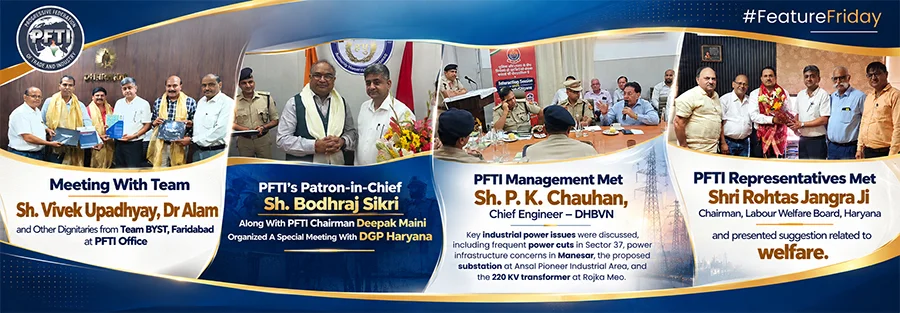
Industry welfare becomes meaningful when leadership turns shared business concerns into practical action.
PFTI approaches industry welfare through collaboration, representation, knowledge sharing, and industry connections.
Why Industry Welfare Needs Active Leadership
Industry welfare improves when leaders remain connected with these realities instead of working only through formal statements.
Industry welfare therefore depends on leadership that is visible, accessible, informed, and willing to work across sectors.
PFTI Leadership and Industry Welfare
PFTI’s leadership structure brings together experienced professionals from different industries and functional areas. Its public platform highlights business leaders, committee chairpersons, and sector specialists working across areas such as power, GST, international business, and industry representation.
This diversity matters for industry welfare because businesses rarely face only one type of challenge.
Leadership with varied experience can help the organisation examine issues from more than one angle.
PFTI’s Team page gives businesses a view of the people and committee leadership within the federation.
Industry Welfare Begins With Listening
An industry body cannot support businesses effectively if it assumes what they need.
Industry welfare begins by listening to companies of different sizes, sectors, and locations. A large manufacturer may have different priorities from a small supplier. An exporter may face challenges that a domestic business does not. A service company may experience regulation differently from a factory.
Listening helps identify which concerns are isolated and which are shared widely.
Industry welfare becomes more useful when feedback is collected, compared, and understood before recommendations are made.
Collaboration Strengthens Industry Welfare
Many business problems cannot be solved by one organisation alone.
A power issue may require dialogue with utilities. A skills problem may involve educational institutions. A market-access challenge may need buyers, trade bodies, or international partners. A policy question may require government engagement and technical expertise.
Industry welfare improves when associations create collaboration between the people who understand the problem and those who can influence the solution.
PFTI’s wider work with institutions, industry professionals, and collaborative partners reflects this principle: stronger outcomes often come from bringing complementary capabilities together.
Industry Welfare Through Knowledge Sharing
Businesses make better decisions when they have access to relevant knowledge.
Industry welfare includes helping companies understand market changes, regulatory developments, emerging technologies, government schemes, and practical business practices.
PFTI’s Knowledge Hub is designed around industry updates, expert knowledge, research, trends, and peer learning.
This matters because information gaps can be costly. A business that learns about a regulatory change late may face avoidable disruption. A company that misses a new market or technology trend may lose time against competitors.
Industry Welfare and Policy Representation
Policies affect production, investment, employment, trade, taxation, infrastructure, and long-term planning.
Industry welfare requires a credible route through which businesses can explain how those policies work in practice.
PFTI has repeatedly emphasised policy advocacy and representation as part of its role. When businesses share evidence, operational examples, and practical recommendations, industry bodies can help carry those perspectives into wider discussions.
Industry welfare is strongest when representation is evidence-based rather than emotional. Clear facts, measurable impact, and realistic solutions make business concerns easier for stakeholders to understand.
Industry Welfare Is More Than Advocacy
Representation is important, but businesses also need opportunities to connect, learn, and grow.
Industry welfare can include networking, mentorship, market insights, training, business matchmaking, global connections, and access to experienced professionals.
These activities strengthen companies even when no policy issue is involved.
An entrepreneur may find a supplier through one event, a mentor through another, and a potential international partner through a third. Industry welfare becomes practical when the network creates opportunities that businesses can actually use.
Industry Welfare Depends on Stronger Business Networks
Business relationships create resilience.
A company with trusted suppliers, advisers, customers, and industry contacts has more options when conditions change. Networks also help businesses compare experiences and learn how others have solved similar problems.
The wider role of trade associations commonly includes advocacy, education, networking, standards, and information sharing. Readers can explore this broader model through Wikipedia’s overview of a trade association.
PFTI’s emphasis on networking and collaboration fits within this wider tradition of organised business communities.
Industry Welfare and International Collaboration
Indian businesses increasingly operate in an interconnected global economy.
Export opportunities, technology partnerships, international investment, global supply chains, and new market relationships can all influence growth.
Industry welfare therefore includes helping businesses understand and connect with opportunities beyond domestic markets.
Such engagement can expose companies to new standards, technologies, customer expectations, and partnership models. Industry welfare becomes broader when domestic businesses are connected with global knowledge and commercial opportunities.
Industry Welfare Requires Sector Expertise
General business advice cannot answer every technical problem.
Power, GST, exports, manufacturing, sustainability, technology, labour, and finance each involve specialised knowledge.
This is one reason committees matter. A specialised committee can understand technical details, compare member experiences, and help convert complex issues into clearer recommendations.
Industry welfare improves when the right expertise is matched with the right problem instead of treating every concern as a general networking issue.
Industry Support Means Supporting MSMEs Too
Large companies often have access to consultants, legal teams, policy specialists, and professional networks. Smaller businesses may not.
Industry support is especially important for MSMEs because they often need shared platforms to access knowledge, representation, and connections without building every capability internally.
A small manufacturer may benefit from learning about a government scheme, meeting a larger buyer, understanding a compliance issue, or joining a sector discussion.
Industry support should therefore create practical access, not only prestige. A strong business community becomes stronger when smaller enterprises can participate meaningfully.
Industry Support in a Changing Economic Environment
Industry priorities can change quickly because of trade conditions, global competition, technology, regulation, and supply-chain shifts.
Recent developments illustrate this pressure. Reuters reported in October 2026 that India-US trade negotiations had reached a difficult stage, with tariffs and market-access questions narrowing the room for agreement. Read the Reuters report.
For businesses, such developments can affect exports, sourcing, planning, and investment confidence.
Industry support becomes more important when companies need timely information, collective discussion, and a clearer understanding of how changing external conditions may affect them.
Industry Support Should Focus on Practical Outcomes
Activity alone should not be confused with impact.
An industry body can organise many events and still fail to improve the experience of its members.
Industry support should be judged by whether businesses gain useful knowledge, meaningful connections, clearer representation, better access to opportunities, and stronger understanding of the issues affecting them.
However, industry support should always remain connected to a practical purpose rather than becoming an exercise in visibility alone.
Industry Support Needs Follow-Through
Listening creates expectations.
If businesses raise concerns, industry support requires a process for what happens next. Issues should be documented, assigned, researched, discussed with relevant people, and updated where possible.
The same principle applies to collaborations and events. A useful introduction should be followed by a route for continued engagement.
Not every concern will be resolved, and not every partnership will develop further. industry support remains credible when the process is transparent and members understand both progress and limitations.
Leadership, Collaboration and Industry Support Work Together
Leadership provides direction. Collaboration brings complementary strengths. industry support keeps the purpose focused on the wider business community.
Strong leadership without collaboration can become isolated. Collaboration without direction can become unfocused. Activity without an industry support objective can become ceremonial.
PFTI’s broader platform is most valuable when leadership, committees, partnerships, knowledge resources, advocacy, and member engagement work as connected parts of one ecosystem.
That is how an association can move from simply representing businesses to helping them become better connected, better informed, and better prepared.
Conclusion: Industry Support Is Built Through Consistent Action
It is the cumulative result of listening to businesses, sharing knowledge, creating connections, building partnerships, developing sector expertise, supporting MSMEs, and representing practical concerns responsibly.
The real test is consistency. Businesses need platforms that remain useful when markets change, policies evolve, new technologies emerge, and unexpected challenges appear.
A stronger industry is not created by one organisation acting alone. It is built when businesses, experts, institutions, and leaders work together around shared progress.
That is the spirit behind PFTI in action: leadership that listens, collaboration that connects, and industry support that keeps the wider business community at the centre.