

Progress becomes more meaningful when business growth genuinely improves people’s lives. Strong markets, technology, and efficient operations matter, but so do healthy, informed, capable employees. PFTI initiatives connect these priorities through partnerships focused on financial wellbeing, workforce health, learning, and industry development.
By bringing industry, institutions, professionals, and social organisations together, PFTI initiatives aim to support progress that strengthens both businesses and the people who sustain them over time.
Why PFTI Initiatives Put People at the Centre of Progress
Every factory, office, startup, and enterprise ultimately depends on people. Machines can improve productivity and technology can accelerate decisions, but people still solve problems, build relationships, manage risk, innovate, and create trust.
PFTI initiatives recognise that business development and human development are closely connected. When employees are healthier, financially more aware, better informed, and supported in their professional growth, organisations can build stronger foundations for performance.
This people-first approach does not replace commercial goals. Instead, PFTI initiatives add a wider perspective by asking how business networks and partnerships can create benefits that reach employees and the broader ecosystem.
PFTI Initiatives and the Value of Collaborative Partnerships
Many workplace challenges require more than one kind of expertise. A trade and industry platform may understand the needs of businesses, while a university can contribute academic and health expertise, and a social organisation may bring experience in community-focused programmes.
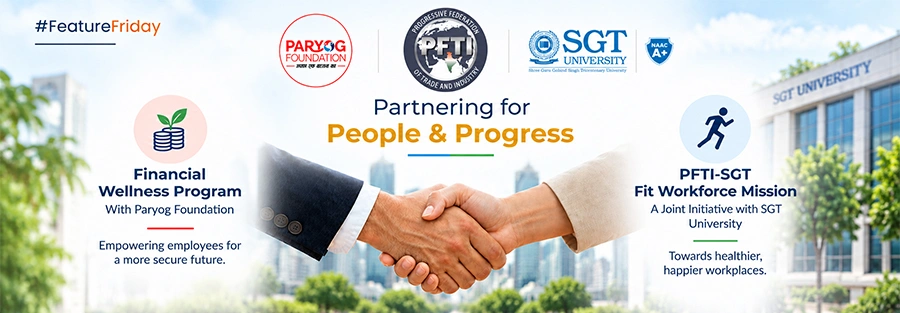
That is why collaboration is central to PFTI initiatives. The partnership between PFTI, Prayog Foundation, and SGT University reflects the value of bringing different capabilities together for practical outcomes.
Rather than treating partnerships as ceremonial associations, PFTI initiatives can create greater value when each partner contributes knowledge, access, implementation capability, and a clear understanding of the people being served.
Readers can explore the organisation’s broader mission and collaborative approach on the PFTI About Us page.
Financial Wellness as Part of PFTI Initiatives
Financial stress does not remain outside the workplace. Concerns about savings, debt, emergencies, insurance, or future planning can affect concentration, confidence, and overall wellbeing. Financial awareness can therefore be a useful part of employee support.
One of the PFTI initiatives highlighted through collaboration with Prayog Foundation focuses on financial wellness. The purpose is to help employees develop greater awareness of personal financial decisions and work towards a more secure future.
PFTI initiatives in this area are relevant because financial wellbeing is not simply about income. It also involves understanding money, planning ahead, recognising risk, and making informed choices.
For employers, supporting financial awareness can be part of a broader wellbeing culture without attempting to make personal decisions for employees. PFTI initiatives can help create access to knowledge while leaving individuals in control of their own financial choices.
How PFTI Initiatives Can Support a Fit Workforce
Employee health and workplace performance are connected in practical ways. Energy levels, mobility, stress, sleep, fitness, and preventive awareness can affect how people feel and function during the working day.
The PFTI-SGT Fit Workforce Mission brings this issue into focus. Through collaboration with SGT University, PFTI initiatives can encourage healthier habits and greater awareness across workplaces.
A fit workforce does not mean creating unrealistic health standards. It means making health awareness more accessible and encouraging people to take practical steps that support their wellbeing.
PFTI initiatives related to workforce health can also help employers think beyond occasional wellness events. The stronger opportunity is to build habits, awareness, and workplace cultures that make healthier choices easier to sustain.
PFTI Initiatives Connect Employee Wellbeing With Business Strength
Supporting people is often described as a social responsibility, but it can also be linked with how organisations function. Employees who feel supported, informed, and respected may be better positioned to participate fully in their work.
PFTI initiatives bring attention to the connection between wellbeing and organisational strength without reducing people to productivity metrics. The objective is not to treat health or financial awareness only as tools for output. It is to recognise that stronger people contribute to stronger organisations.
Recent reporting on India’s manufacturing sector has also shown how business momentum and hiring can move together. Reuters reported that factory activity accelerated in September 2026 and hiring revived as demand improved. Read the Reuters report on India’s manufacturing activity.
As industry expands, PFTI initiatives that focus on people can become increasingly relevant to how businesses manage growth responsibly.
Building Awareness Through PFTI Initiatives
Awareness is often the first step before behaviour changes. People may know that financial planning, physical activity, preventive health, or professional learning are important, yet still lack reliable information or a practical starting point.
PFTI initiatives can help close this gap by creating structured opportunities for experts and participants to interact. Workshops, awareness sessions, institutional collaborations, and industry forums can translate broad ideas into more understandable actions.
The value of PFTI initiatives is strongest when information is practical, credible, and suited to the audience. Employees in a manufacturing unit may have different concerns from young professionals, business owners, or students.
By designing programmes around real needs rather than generic messaging, PFTI initiatives can make participation more useful and relevant.
PFTI Initiatives and Responsible Business Culture
A responsible business culture is built through repeated decisions, not one-time campaigns. It includes how organisations treat employees, communicate with stakeholders, manage resources, and contribute to the communities around them.
The broader idea connects with corporate social responsibility, which includes business efforts to consider social and environmental impacts alongside commercial activity. Readers who want background on the concept can review Wikipedia’s overview of corporate social responsibility.
PFTI initiatives can support this mindset by encouraging businesses to view people-related programmes as part of long-term organisational development rather than isolated acts.
When responsibility becomes part of everyday culture, PFTI initiatives can help strengthen the connection between business success and positive social outcomes.
Skills, Learning and PFTI Initiatives for Long-Term Progress
Health and financial wellbeing are important, but people also need opportunities to learn and adapt. Industries are changing through automation, digital tools, new compliance expectations, evolving customer needs, and global competition.
PFTI initiatives can contribute by connecting businesses and professionals with knowledge, experts, peers, and learning opportunities. This is especially valuable for smaller organisations that may not have dedicated teams for every new challenge.
The PFTI Knowledge Hub provides industry insights, peer learning, studies, and market-oriented knowledge that can complement people-focused programmes.
PFTI initiatives that combine wellbeing with learning create a broader model of progress: people become more prepared personally and professionally, while organisations gain access to stronger capabilities.
Why PFTI Initiatives Need Measurable Outcomes
Good intentions are valuable, but meaningful programmes also need clear outcomes. PFTI initiatives should be assessed through measures that match their purpose rather than through publicity alone.
For financial wellness, useful indicators may include participation, knowledge improvement, or the number of employees who report greater confidence in understanding key financial concepts. For workforce health, measures may focus on participation, awareness, or continued engagement with healthier practices.
PFTI programmes do not need to promise dramatic results to be useful. Small, measurable improvements can create lasting value when programmes are consistent and responsive to participant feedback.
Measurement also helps partners improve future PFTI programmes by understanding what people found useful, where participation dropped, and which formats created the strongest engagement.
PFTI programmes Can Create Value Beyond a Single Organisation
One of the advantages of an industry platform is its ability to connect organisations that may otherwise work separately. A useful programme tested in one workplace can inspire better practices elsewhere. An expert session can benefit participants from multiple sectors. A partnership can create a model that other institutions adapt.
PFTI programmes therefore have the potential to generate shared learning beyond an individual company. This matters because many businesses face similar challenges even when their products and markets are different.
When PFTI programmes encourage organisations to exchange experience, the value of one programme can extend into a wider network. That is how collaboration begins to create ecosystem-level progress.
The Future of PFTI programmes Is People-Led Progress
India’s industrial future will depend on investment, technology, infrastructure, exports, and innovation. It will also depend on whether people have the health, skills, confidence, and support needed to participate in that future.
PFTI programmes reflect a simple but important principle: sustainable progress should strengthen both organisations and the people within them. Partnerships with foundations, universities, experts, and industry can help turn that principle into practical action.
The most meaningful PFTI programmes will be those that remain grounded in real needs, respect individual choice, use credible expertise, and improve through measurable feedback.
Building a better future is not the responsibility of one institution. It requires businesses, educational organisations, professionals, community groups, and employees to contribute from their areas of strength.
That is why PFTI programmes matter. They create a platform where collaboration can move beyond discussion and become useful action. When people are supported, businesses become stronger. When businesses grow responsibly, communities gain new opportunities. And when both move forward together, progress becomes more inclusive, practical, and lasting.