
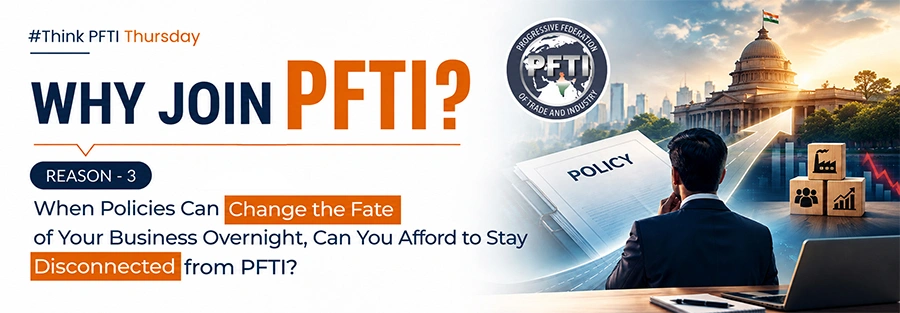
Policy changes can influence pricing, compliance, hiring, investment, imports, exports, and day-to-day operations. A business that notices an important rule only after a deadline may face unnecessary disruption. That is why business policy updates should be treated as part of planning, not simply as news.
PFTI positions policy awareness, publications, knowledge sharing, advocacy, and representation as part of its support ecosystem. The practical value of business policy updates is simple: understand what changed, who is affected, when it applies, and what action may be required.
Why Business Policy Updates Matter
Government policy creates the framework within which companies operate. Tax rules, labour requirements, environmental standards, trade regulations, incentives, licensing, and sector-specific notifications can all affect costs and decisions.
Business policy updates help companies identify relevant changes before they become urgent problems. They can also reveal schemes, incentives, or reforms that create new opportunities.
It needs business policy updates that are relevant to its sector, location, size, and operating model.
Business Policy Updates Are More Than Headlines
A headline may tell you that a policy changed, but it rarely explains what your company should do next.
Useful business policy updates should answer practical questions: What changed? Which businesses are covered? When does it take effect? Is it final, proposed, or under consultation? Which systems or documents may need attention?
Public policy can include laws, regulations, guidelines, programmes, and government actions. Wikipedia’s overview of public policy provides useful background on how public policy affects employment, finance, economics, transport, and administration.
Business policy updates become valuable when formal information is translated into business relevance.
How PFTI Supports Business Policy Updates
PFTI’s Services page states that its publications include industry trends, policy updates, and best practices. It also lists policy advocacy and representation among its support areas.
This gives business policy updates a wider role inside the PFTI ecosystem. Information can be connected with expert views, member concerns, and practical industry experience.
Businesses can explore these support areas on the PFTI Services page.
Business policy updates are more useful when companies can understand the change and also raise questions about its practical impact.
Business Policy Updates Reduce Compliance Surprises
Many compliance problems occur because information reaches the responsible team too late.
A tax change may reach finance but not sales. A labour notification may reach HR but not plant administration. A trade rule may affect procurement, logistics, and customers at the same time.
Business policy updates can act as an early-warning system. Once a relevant change is identified, responsibility can be assigned before the deadline becomes urgent.
The strongest business policy updates do not stop at awareness; they make it clear who inside the company should respond.
Business Policy Updates Can Affect Cost and Pricing
Policy changes can alter the economics of a product or service.
Taxes, duties, fees, incentives, wage requirements, environmental obligations, or import conditions may affect margins and quotations. Business policy updates give management time to review pricing, contracts, sourcing, and budgets.
A current example is the debate around UPI merchant fees and taxation. Reuters reported in September 2026 that India hoped the GST Council would review the 18% tax on merchant discount rates for certain UPI transactions after a new fee framework drew concern from retailers. Read the Reuters report.
The lesson is that business policy updates can have direct commercial consequences even when a change appears technical.
Business Policy Updates Support Better Investment Decisions
Capital investment often depends on policy assumptions.
A manufacturer considering a new unit may need clarity on power, labour, environmental approvals, land rules, industrial incentives, or state support. An exporter may need to monitor duties, documentation, standards, or trade measures.
Business policy updates help management test whether the assumptions behind an investment remain valid.
This does not mean every decision should wait for complete certainty. It means business policy updates should be part of risk assessment whenever policy can materially change the economics of a project.
Business Policy Updates Support Industry Representation
Businesses do not only receive policy; they also experience its practical effects.
A rule may create duplication, increase paperwork, or affect smaller companies differently from large ones. Business policy updates give enterprises a factual starting point for documenting these effects.
Once a change is understood, businesses can contribute evidence-based feedback through appropriate industry platforms.
PFTI states that policy advocacy and representation are part of its services. Business policy updates therefore support both awareness and informed participation.
Why MSMEs Need Business Policy Updates
Large companies may have legal, tax, compliance, and government-relations teams. Many MSMEs do not.
For a smaller enterprise, a few managers may handle operations, finance, people, compliance, and strategy at the same time. Business policy updates can reduce the burden of searching through multiple information sources without context.
The most useful business policy updates explain relevance rather than simply repeating official language.
Business Policy Updates Must Separate Proposals From Final Rules
Consultation papers, draft rules, proposed amendments, committee recommendations, and media reports do not always become final policy in the same form.
Business policy updates should therefore label the status of a development clearly.
Companies need to know whether immediate action is required, whether preparation should begin, or whether the issue should simply be monitored.
Reliable business policy updates should also be revised when a proposal changes, a deadline moves, or a final notification is issued.
Using Business Policy Updates Inside Your Company
Receiving information is only the first step. A business needs a routine for converting information into action.
Regulatory updates for businesses can be processed through five questions: Does this apply to us? Which department owns it? What is the operational or financial impact? What is the deadline? Has the required action been completed?
Regulatory Updates for Businesses Belong in Leadership Meetings
Some policy changes are too important to remain inside a compliance department.
An export requirement may affect market selection. A tax change may influence pricing. An incentive may alter the economics of capital expenditure. A labour policy may influence workforce planning.
Regulatory updates for businesses should therefore reach leadership when the strategic or commercial impact is significant.
Senior management does not need every notification in full. It needs regulatory updates for businesses that summarise the change, likely impact, uncertainty, and decision required.
How the PFTI Knowledge Hub Supports Regulatory Updates for Businesses
PFTI’s Knowledge Hub is built around industry-specific updates, reports, peer learning, expert knowledge, and market trends.
The PFTI Knowledge Hub can complement regulatory updates for businesses by giving companies wider context around markets, technology, and sector developments.
Policy rarely changes in isolation. regulatory updates for businesses are easier to interpret when companies understand the economic and industry trends surrounding them.
Regulatory Updates for Businesses Can Reveal Opportunities
Policy is often discussed only as a compliance burden, but policy change can also create opportunity.
Government programmes may support technology adoption, energy efficiency, exports, training, credit access, quality improvement, or formalisation. regulatory updates for businesses can help companies recognise these opportunities earlier.
The advantage comes from preparation. A company that understands eligibility, documentation, timelines, and strategic fit can act faster than one that discovers a programme at the last moment.
Good regulatory updates for businesses therefore highlight both obligations and opportunities.
Regulatory Updates for Businesses Need Reliable Sources
Regulatory updates for businesses should be checked against official notifications, regulator websites, ministry releases, credible news reporting, or qualified professional guidance where interpretation is complex.
Forwarded messages and screenshots may provide an early signal, but they should not be treated as final authority.
Reliable regulatory updates for businesses should include the source, date, status, and scope of the change so that businesses can verify what they are acting on.
Staying Ahead With Regulatory Updates for Businesses From PFTI
Staying ahead does not mean predicting every government decision. It means creating a habit of monitoring change, understanding relevance, and acting early.
PFTI can support this process through publications, knowledge resources, policy advocacy, representation, and member engagement.
Regulatory updates for businesses are most useful when they connect information, interpretation, and action.
For businesses, the goal is straightforward and practical: know what changed before it becomes urgent, understand what it means before deciding, and contribute evidence when an industry-wide issue needs representation.
Conclusion: Make Policy Awareness a Business Habit
Policy change is a normal part of a growing economy. The risk comes when businesses notice important changes too late.
Regulatory updates for businesses help companies prepare for new responsibilities, identify opportunities, protect margins, plan investments, and participate more effectively in industry dialogue.
PFTI’s combination of publications, knowledge sharing, policy awareness, and representation can help businesses stay closer to the changes shaping their operating environment.
The strongest approach is not to react to every headline. It is to build a disciplined process for checking reliable sources, assessing relevance, assigning responsibility, and completing action.
When policy awareness becomes part of business planning, companies are prepared to respond with clarity rather than urgency.