

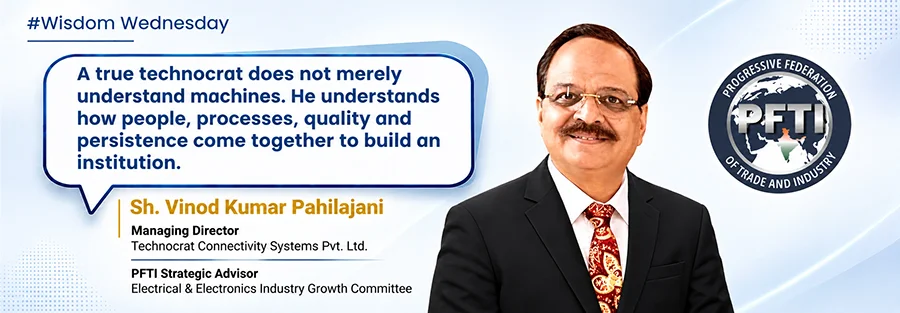
A technocrat is often associated with technical knowledge, engineering discipline, data, systems, and problem-solving. But the most valuable technocrats do more than solve today’s technical issue. They create organisations that continue to perform after the immediate problem has disappeared. That is the deeper meaning of institution building leadership: building people, processes, quality standards, and persistence into one dependable institutional system.
A strong institution does not depend on one brilliant individual rescuing every situation. It creates capability across teams, documents how work should happen, maintains standards when pressure rises, and continues improving over time. institution building leadership turns personal expertise into organisational strength. For PFTI’s business community, this is especially relevant as Indian enterprises scale, adopt technology, compete globally, and move from founder-driven execution toward professional management.
Why Institution Building Leadership Is More Than Technical Expertise
institution building leadership asks a larger question: can the organisation repeatedly solve such problems without depending on the same person every time?
Institution Building Leadership Starts With the Right People
institution building leadership begins by placing capable people in roles where expectations, authority, and accountability are clear.
Institution Building Leadership Turns Individual Knowledge Into Process
institution building leadership converts that knowledge into processes that others can understand and improve.
Processes preserve learning.
Institution Building Leadership Requires Process Without Bureaucracy
institution building leadership should not create paperwork for its own sake.
Technocrats should therefore review systems regularly.
PFTI’s Systems Thinking Supports Institution Building Leadership
PFTI’s article Chanakya Would Trust Your People, But Would He Trust Your System? highlights an important principle: good people cannot replace dependable systems.
This aligns closely with institution building leadership.
Institution Building Leadership Makes Quality a Daily Discipline
institution building leadership treats quality as something built into the way work is designed.
Institution Building Leadership Requires Root-Cause Thinking
institution building leadership depends on root-cause thinking across the organisation.
Institution Building Leadership Uses Corrective Action to Build Institutional Memory
institution building leadership turns corrective action into institutional memory.
Reuters reported in November 2026 that India proposed immediate suspension of drug-manufacturing licences for specified quality failures until manufacturers complete satisfactory root-cause analysis and corrective and preventive action. Read the Reuters report.
Institution Building Leadership Connects Quality With Accountability
institution building leadership requires every critical process to have someone responsible for its performance.
Institution Building Leadership Builds Persistence Into the Culture
institution building leadership requires persistence because systems improve through repeated use, review, correction, and reinforcement.
Institution Building Leadership Must Survive Leadership Changes
institution building leadership is successful when customers, employees, suppliers, and processes continue functioning without crisis.
PFTI’s article Leadership Succession Planning explains that succession is measured by genuine transfer of responsibility rather than by a title change alone.
Institution Building Leadership Requires Leaders to Stop Being the Emergency Department
institution building leadership requires them to resist becoming the permanent solution to every emergency.
PFTI’s article Are You the Architect of Your Business — or Its Permanent Emergency Department? argues that founders should build systems that allow the organisation to operate beyond constant personal intervention.
The same principle applies to technocrats.
Institution Building Leadership Develops Decision-Making Capability
institution building leadership defines which decisions require senior approval and which should be handled by trained teams.
The goal is controlled independence.
Institution Building Leadership Needs Data, but Data Must Lead to Action
Technocrats usually value measurement.
institution building leadership uses data to improve decisions rather than simply create dashboards.
A metric should answer a management question.
Quality rejection rates can reveal process instability. Downtime can identify maintenance priorities. Customer complaints can expose recurring design problems. Energy use can reveal inefficiency.
The purpose is not to collect every number available.
It is to connect the right measures with responsibility and action.
Data becomes institutional knowledge only when people know what it means and what they should do when performance moves outside an acceptable range.
Institutional Leadership Discipline Connects Technology With Process Redesign
Technology alone does not create a strong institution.
Institutional leadership discipline asks whether new tools improve how the organisation makes decisions, shares information, controls quality, and serves customers.
Reuters reported in August 2026 that companies investing heavily in AI often improve individual functions without becoming more resilient because sourcing, manufacturing, logistics, planning, incentives, and decision structures remain disconnected. Read the Reuters analysis.
The lesson applies far beyond AI.
Technology creates value when processes and responsibilities evolve with it.
Institutional Leadership Practice Requires Cross-Functional Thinking
Institutions become fragile when departments optimise only themselves.
Institutional leadership practice connects engineering, production, quality, procurement, finance, sales, HR, and customer service around shared outcomes.
A procurement decision can affect quality. A sales commitment can affect capacity. A design change can affect cost and service. A staffing decision can affect safety and output.
Technocrats who understand these connections make stronger institutional leaders because they see the organisation as a system rather than as isolated functions.
Cross-functional thinking reduces the risk that one department’s improvement becomes another department’s problem.
Institutional Leadership Discipline Makes Quality Visible to Suppliers
Institutional quality extends beyond the company gate.
Institutional leadership discipline includes suppliers because purchased materials, components, services, and outsourced processes directly affect final performance.
A strong organisation defines supplier expectations, evaluates capability, communicates specifications, tracks recurring defects, and supports corrective action where appropriate.
Supplier development can be more valuable than repeatedly changing vendors.
The objective is to build a supply network that understands the same standards the company expects internally.
Institutional Leadership Practice Includes Customer Feedback as a Technical Input
Customers experience the final result of the institution’s processes.
Institutional leadership practice treats customer feedback as data for improvement rather than as a problem for the sales team alone.
Complaints can reveal design weaknesses, packaging problems, unclear instructions, service gaps, or quality variation.
Positive feedback can also show which processes are working well.
A technocrat who listens to customers gains information that internal metrics may miss.
The organisation becomes stronger when market experience feeds back into technical and operational improvement.
Institutional Leadership Discipline Requires Quality Under Pressure
Standards are easiest to follow when demand is stable and time is available.
Institutional leadership discipline is tested when orders surge, delivery deadlines tighten, costs rise, or a major customer creates pressure.
Weak institutions begin bypassing controls.
Strong institutions understand which standards cannot be compromised and where flexibility is safe.
This is why process design should consider abnormal conditions, not only ideal operations.
Quality that disappears under pressure was never fully institutionalised.
Institutional Leadership Practice Develops Problem Solvers, Not Dependents
A strong technocrat does not want every team member to ask for the answer.
Institutional leadership practice develops people who can identify problems, analyse evidence, test causes, and recommend solutions.
Leaders can support this by asking questions before giving instructions.
What changed? What evidence do we have? What are the possible causes? What have we already tested? What risk exists if we act?
This approach builds judgement.
Over time, the organisation gains more people capable of solving problems independently.
Institutional Leadership Discipline Requires Standards That Can Improve
Standardisation does not mean freezing the organisation.
Institutional leadership discipline creates a current best-known way of working and then improves it when better evidence appears.
Employees should understand that a standard is not a permanent commandment.
It is a baseline for consistency and learning.
Changes should still be controlled, documented, communicated, and tested where appropriate.
This prevents two extremes: chaotic improvisation and rigid bureaucracy.
PFTI’s Vision Supports Institutional Leadership Discipline
The PFTI About Us page emphasises innovation, empowerment, integrity, excellence, and collaboration.
These values support institutional leadership discipline because institutions are built through more than technical efficiency.
Innovation improves systems. Empowerment develops people. Integrity protects trust. Excellence strengthens quality. Collaboration connects functions and partners.
A technocrat becomes an institutional leader when technical competence is combined with these wider organisational responsibilities.
The result is not simply a better process.
It is a stronger enterprise.
Institutional Leadership Practice Is Ultimately About Continuity
The strongest institution keeps improving beyond the person who started the improvement.
Institutional leadership practice creates continuity through trained people, clear processes, quality discipline, documented learning, leadership development, and persistence.
The leader’s legacy is therefore not the number of problems they personally solved.
It is the number of problems the organisation learned to solve without them.
That is the difference between being indispensable and building something enduring.
Conclusion: Institutional Leadership Discipline Turns Expertise Into an Institution
A true technocrat brings technical knowledge to the table, but does not stop there.
Institutional leadership discipline combines people, process discipline, quality, accountability, data, learning, technology, and persistence so that capability becomes part of the organisation itself.
Strong institutions are not created by slogans or one-time transformation projects.
They are built through thousands of repeated decisions: training someone properly, documenting a process, refusing a quality shortcut, investigating a root cause, developing a successor, listening to a customer, and improving the system again.
When leaders build in this way, their expertise survives beyond their own involvement.
That is when technical excellence becomes institutional strength.