
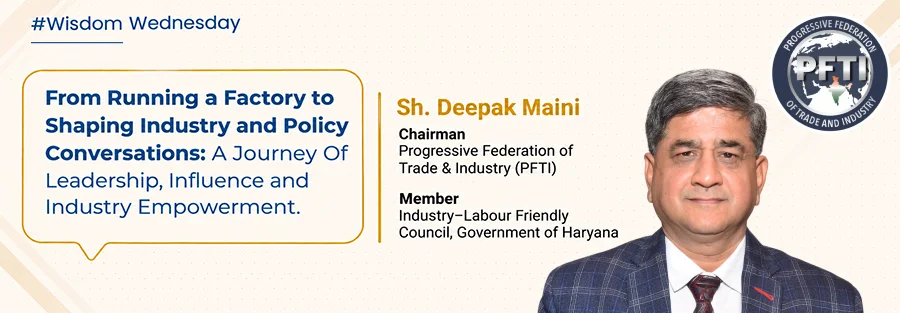
Running a factory teaches leadership in a direct way. Production must move, customers must be served, people must be managed, quality must be protected, cash must be controlled, and problems rarely wait for a convenient time. But for some leaders, experience eventually creates a wider responsibility. They begin to see that many problems inside one enterprise are connected to challenges across an entire sector. That is where an industry leadership journey begins to move beyond the factory gate.
The shift is not about leaving business behind. It is about using business experience more broadly. A leader who has managed real operations can recognise how policy, infrastructure, skills, finance, energy, compliance, technology, and markets shape industrial performance. An industry leadership journey becomes more influential when operational experience is converted into mentoring, collective representation, structured dialogue, and practical ideas that help more than one company.
Why an Industry Leadership Journey Usually Starts With Operational Reality
An industry leadership journey becomes meaningful when the leader has lived through production delays, customer pressure, quality failures, manpower shortages, working-capital stress, supplier problems, and changing regulations.
An Industry Leadership Journey Expands When One Factory Problem Becomes an Industry Pattern
An industry leadership journey begins to widen when the same issue appears repeatedly across neighbouring companies, suppliers, customers, or industry peers.
An Industry Leadership Journey Requires Listening Beyond Your Own Business
An industry leadership journey becomes stronger when leaders listen to businesses that operate differently from their own.
PFTI’s Founders Page Reflects an Industry Leadership Journey
The PFTI Founders page describes leadership backgrounds connected with industrial associations, business transformation, mentoring, trade, and broader institution-building.
These examples show how an industry leadership journey can evolve from professional expertise into wider responsibility.
An Industry Leadership Journey Moves From Individual Success to Collective Impact
An industry leadership journey creates a different question: what can this experience contribute to the wider ecosystem?
An Industry Leadership Journey Requires the Ability to Translate Experience
An industry leadership journey develops when leaders can convert an experience into a clearly defined issue.
PFTI’s Industry Representation Work Supports an Industry Leadership Journey
PFTI’s article PFTI Brings the Ground Realities of Factories and Markets to Policymakers explains how business experience can be documented, organised, and brought into wider policy discussions.
This reflects a key stage in an industry leadership journey.
An Industry Leadership Journey Builds Influence Through Credibility, Not Volume
An industry leadership journey becomes sustainable when people trust the leader’s judgement.
An Industry Leadership Journey Requires Understanding Policy Objectives
An industry leadership journey becomes more mature when leaders understand why a policy exists before recommending how it should change.
An Industry Leadership Journey Can Turn Complaints Into Policy Dialogue
An industry leadership journey creates value when concerns are converted into specific questions and practical recommendations.
PFTI’s Industry Policy Dialogue content describes a process of moving from business challenges toward structured discussion, clarification, and possible reform.
An Industry Leadership Journey Requires Evidence From the Ground
An industry leadership journey should be supported by data from multiple businesses wherever possible.
An Industry Leadership Journey Can Help Industry Participate Before Decisions Become Final
An industry leadership journey is more effective when business feedback arrives during consultation rather than after every decision is fixed.
Reuters reported in October 2026 that Indian insurance brokers collectively challenged proposed reforms, sought an impact assessment, and requested more consultation time over commission-related changes. Read the Reuters report.
The example shows the value of organised sector participation.
An Industry Leadership Journey Must Represent More Than Personal Interest
An industry leadership journey should consider how a proposed change affects MSMEs, large companies, employees, customers, suppliers, and the wider ecosystem.
Leaders need to disclose conflicts and listen to different member positions.
Collective leadership requires fairness.
The goal is not perfect consensus.
It is a credible understanding of where shared interests exist and where differences need to be explained honestly.
An Industry Leadership Journey Includes Mentoring the Next Generation
Influence becomes more valuable when it develops other leaders.
An industry leadership journey should therefore include mentoring, coaching, and knowledge-sharing.
Experienced industrialists understand realities that cannot be learned only from books: customer negotiations, labour challenges, machine breakdowns, credit cycles, supplier failures, regulatory surprises, and the emotional pressure of responsibility.
Sharing that experience helps younger entrepreneurs develop judgement faster.
Mentoring also protects institutional memory.
An industry becomes stronger when every generation does not have to rediscover the same lessons from zero.
An Industry Leadership Path Expands Through Networks and Committees
One leader cannot understand every sector.
An industry leadership path becomes more informed through contact with specialists in taxation, labour, energy, finance, technology, exports, quality, environment, and regulation.
PFTI’s committees and wider network create a structure where different kinds of expertise can meet.
Cross-functional exposure helps leaders understand how one issue connects with another.
For example, an energy policy may affect production cost, sustainability targets, investment decisions, and export competitiveness simultaneously.
Industry leadership improves when conversations are not trapped inside one professional discipline.
An Industry Leadership Path Requires the Humility to Keep Learning
Experience is valuable, but markets keep changing.
An industry leadership path can weaken if a leader assumes that yesterday’s success automatically proves today’s judgement.
Technology, customer expectations, regulation, financing, sustainability, and global supply chains continue to evolve.
Influential leaders remain students.
They ask younger professionals about new technologies. They listen to experts outside their field. They update their assumptions when evidence changes.
Humility protects relevance.
A leader who stops learning eventually represents the industry that existed in the past rather than the industry that is emerging.
An Industry Leadership Path Can Strengthen Collective Industry Voice
PFTI’s article One Company Can Raise a Concern. PFTI Can Raise an Industry Voice explains how member concerns become more credible when they are compared, documented, and converted into a shared position.
This is another stage in an industry leadership path.
The leader learns to move from “my issue” to “our evidence.”
That change matters because policymakers need to know whether a concern is unique or widely experienced.
Collective voice is strongest when it is built through listening, expert review, and responsible member input.
An Industry Leadership Path Can Connect Industry With National Opportunity
Industry leadership is not only about solving problems.
An industry leadership path also helps businesses recognise opportunities created by policy, infrastructure, investment, and market change.
Reuters reported in November 2026 that India approved a ₹28.14 billion incentive policy to expand domestic processing of lithium and nickel, aiming to strengthen critical-mineral capability and reduce supply-chain dependence. Read the Reuters report.
Industry leaders can help businesses understand how such developments may affect future supply chains, investment decisions, technology needs, and partnerships.
An Industry Leadership Path Requires Follow-Through After the Meeting
Influence is not created by attending meetings.
An industry leadership path requires discipline after the conversation ends.
Issues must be documented. Additional evidence may need to be collected. Members should receive updates. Commitments should be tracked. Questions should be answered.
Some matters will move quickly. Others may require months of technical review or engagement with multiple institutions.
Leaders build trust when people know they will continue working after the photograph, event, or memorandum disappears from public attention.
Follow-through is what converts access into credibility.
An Industry Leadership Path Should Build Institutions, Not Personality Cults
The strongest industry leadership survives beyond one individual.
An industry leadership path should create committees, knowledge systems, mentoring structures, research processes, member participation, and leadership pipelines.
If every relationship, decision, and initiative depends on one person, the platform becomes fragile.
Institutions multiply influence.
They allow different experts to contribute and make the organisation more credible over time.
The leader’s greatest achievement may therefore be building a structure where others can lead effectively.
PFTI Membership Can Broaden an Industry Leadership Path
The PFTI Membership page highlights policy advocacy, government liaison, market intelligence, networking, committee participation, mentoring, and leadership opportunities.
These channels can broaden an industry leadership path by giving business leaders exposure beyond their own companies.
Participation allows them to compare experiences, contribute expertise, learn from peers, and understand the wider forces shaping industry.
Membership does not automatically create influence.
Influence develops through consistent contribution.
The leaders who gain the most value are often those who come prepared to share as well as receive.
Conclusion: An Industry Leadership Path Moves From Enterprise Success to Industry Empowerment
Running a factory can teach discipline, accountability, resilience, quality, and decision-making.
An industry leadership path begins when those lessons are applied beyond one enterprise.
The leader starts identifying common industry patterns, mentoring others, joining committees, contributing evidence, participating in policy dialogue, and helping build institutions that connect businesses with wider opportunities.
This journey does not require abandoning entrepreneurship.
It expands the meaning of entrepreneurship.
Success is no longer measured only by what one company achieves, but also by how experience helps strengthen the ecosystem around it.
When leadership moves from operating a factory to empowering industry, influence becomes a form of responsibility.