

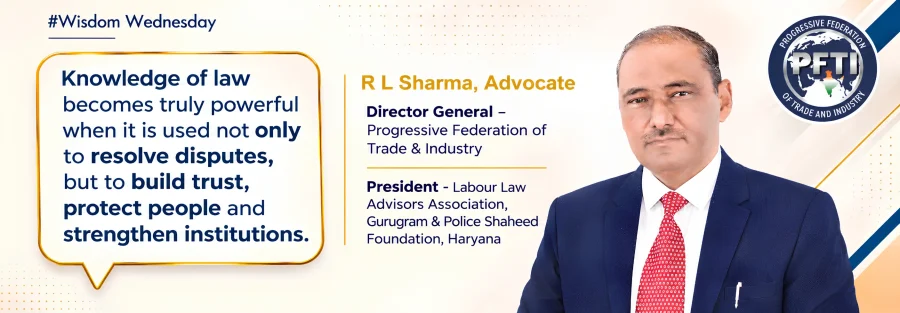
A law book can explain what an organisation must do. It cannot, by itself, make an employee feel safe speaking up, persuade a customer that a promise will be honoured, or convince a small manufacturer that a dispute will receive a fair hearing. That is the difference between possessing information and putting it to work. For the Progressive Federation of Trade & Industry (PFTI), the idea behind legal awareness is not simply avoiding penalties. It is helping industry make decisions that people can understand, trust and defend. In factories, offices and trade associations, legal awareness becomes valuable when it guides everyday conduct, supports fair treatment and creates institutions that remain dependable even when leaders change. An enterprise may be technically compliant yet still struggle with confusion, inconsistent procedures or unresolved grievances. The more meaningful question is whether its knowledge of law produces better behaviour.
Why Legal Awareness Matters Beyond Compliance
Compliance is an essential starting point, but it is not the whole destination. A checklist may confirm that a notice was displayed or a document was filed. Legal awareness asks whether managers understand why a requirement exists and whether the people affected know what to expect. This distinction matters in Indian industry, where owners often juggle production targets, customer obligations, supplier payments and workforce concerns on the same day. Decisions made quickly can become expensive when roles are unclear or records are incomplete.
A business that treats legal awareness as part of planning can identify risks before they become disputes. It can explain terms before signing an agreement, examine a proposed change before implementing it, and maintain records that support fair decisions. The goal is not to make every manager a lawyer. It is to encourage the habit of asking the right questions and involving qualified advisers when necessary.
Legal Awareness Builds Trust Through Consistent Decisions
Trust grows when employees and partners see that rules apply consistently. Imagine two workers raising similar concerns about overtime, leave or an unsafe process. If one receives careful consideration while the other is dismissed without explanation, distrust spreads even if the company has written policies. Legal awareness helps leadership recognise that fairness depends on practice, not attractive statements on a wall. Written procedures, accessible reporting channels and documented responses make decisions easier to understand.
Customers and vendors notice the same qualities. Clear contracts, realistic delivery commitments and prompt communication reduce surprises. When an enterprise acknowledges a mistake and follows an agreed resolution process, it demonstrates reliability. Legal awareness therefore contributes to reputation: not by guaranteeing that conflicts never occur, but by making the response more predictable and transparent.
Protecting People Is the First Test of Legal Awareness
A strong institution starts with the people who make it function. Employees need clear information about workplace responsibilities, grievance routes and safety expectations. Supervisors need to know when a concern requires escalation rather than an informal verbal fix. Legal awareness creates the common language needed for those conversations. It also reminds management that protecting people includes dignity, non-retaliation and attention to foreseeable workplace risks.
India’s occupational safety framework highlights why workplace conditions deserve structured attention. The principles behind the Occupational Safety, Health and Working Conditions Code are useful context, although an employer’s actual duties depend on applicable provisions, notifications, rules and the establishment concerned. Legal awareness must therefore lead to verification, not assumptions. A notice about safety is not enough if employees lack appropriate training or cannot report hazards without fear.
Legal Awareness in Everyday Workplace Conversations
Practical habits make a difference: explain policies in language workers understand, record safety briefings, review complaints without prejudging them, and show employees where to obtain reliable information. For smaller units, even a short monthly conversation between management and staff can reveal unclear processes before they harden into grievances. Legal awareness is strongest when people can ask questions without being embarrassed for not knowing the answer.
Legal Awareness Makes Contracts and Commitments More Reliable
Commercial disputes often begin with different memories of the same conversation. A buyer thinks delivery includes installation; a supplier assumes installation is extra. A founder promises a payment date that finance cannot meet. Legal awareness encourages businesses to define scope, quality checks, timelines, payment conditions, change approvals and dispute-handling steps before disagreements arise. This improves working relationships without turning every negotiation into a confrontation.
MSMEs should pay particular attention to documents that recur across many transactions: purchase orders, vendor onboarding forms, service agreements, employment letters and confidentiality arrangements. A periodic review of standard terms can help eliminate outdated language and contradictory instructions. Legal awareness also means knowing when a complex clause, cross-border commitment or sensitive employee issue should be reviewed by a qualified professional. Templates are helpful; automatic copying is not a substitute for judgment.
Stronger Institutions Need Legal Awareness, Not Personal Exceptions
Many growing businesses depend heavily on one experienced owner or senior manager. Such leadership can be a strength, but an organisation becomes vulnerable when every exception requires a private phone call. If approvals, grievance handling and supplier selection depend solely on personal relationships, the system may fail during expansion or leadership transition. Legal awareness supports institutions by replacing uncertainty with defined authority, documented decisions and transparent escalation paths.
This is closely related to corporate governance: the way organisations are directed, overseen and held accountable. Even businesses without a large board can apply governance principles. They can separate request and approval responsibilities, document conflicts of interest, conduct periodic checks and explain who is responsible for correcting errors. Legal awareness makes these measures meaningful because staff understand why process discipline protects everyone.
The PFTI Perspective: Legal Awareness Through Collective Learning
An industry federation can help businesses recognise common questions and find more informed routes to resolution. PFTI’s services describe support that includes legal challenges and dispute resolution, while its wider work brings companies into dialogue around policy and industrial development. The value of this approach is collective learning: one enterprise’s recurring difficulty can reveal a gap in information or implementation that affects many others.
PFTI’s discussion of industry policy dialogue also points to an important distinction. Not every difficulty requires a new law. Sometimes businesses need clearer guidance, better implementation or a more effective channel to raise evidence-backed concerns. Legal awareness helps representatives explain the practical issue without confusing a personal inconvenience with a regulatory failure. It makes conversations with institutions more constructive.
Legal Awareness Helps MSMEs Prepare for Policy Change
Regulatory developments can affect payroll practices, environmental procedures, documentation, tax administration and commercial decisions. Headlines may identify a change, but they rarely explain every condition or transition rule. Legal awareness means checking the actual notification, its effective date, the jurisdiction, any exceptions and how the rule applies to the organisation. Businesses should distinguish a proposal from an enacted requirement and a general summary from professional advice.
PFTI’s article on business policy updates encourages businesses to follow changing requirements with context. A sensible internal routine is to assign responsibility for monitoring official sources, maintain a register of relevant obligations and note what action was taken. Legal awareness then becomes an ongoing management capability rather than a rushed response when an inspection, customer audit or dispute occurs.
Turn Legal Awareness Into Practical Leadership Habits
Legal knowledge produces results when responsibility is visible. Leaders can start by identifying five recurring decisions that create risk in their workplace: hiring, safety, procurement, payments and customer commitments. For each, write down the person responsible, the supporting documents and the point at which expert review is needed. Introduce a simple system for reporting concerns and acknowledge every report, even when investigation takes longer.
Next, test whether the system works for people with different levels of education and seniority. Can a shop-floor worker understand how to flag a hazard? Can a junior accountant challenge an incomplete approval? Can a vendor find the correct contact when invoices are disputed? Legal awareness should remove unnecessary mystery from business processes. A policy that nobody can use offers little protection.
A Simple Legal Awareness Review for Business Owners
Once a quarter, select a few real decisions and trace what happened. Check whether the rule was communicated, whether evidence was retained and whether similar cases were treated consistently. Ask employees what remains unclear and invite suggestions for improving instructions. Use findings to update training and procedures, not simply to assign blame. A repeatable review habit can strengthen confidence without demanding a large compliance department.
Legal Awareness Should Support Dialogue, Not Fear
When legal discussions are introduced only after a problem, employees may associate them with punishment. A healthier approach presents legal awareness as shared protection. Employers need dependable information to invest and grow. Workers need fair treatment and safe conditions. Customers need promises that can be trusted. Regulators need accurate records and honest engagement. These interests can differ, but transparent processes give each side a clearer starting point.
PFTI’s writing on industry policy representation emphasises the importance of documented concerns and constructive engagement. The same lesson applies inside enterprises. Listening early, separating facts from assumptions and explaining a decision respectfully often protects relationships better than a last-minute legal response. Legal awareness should invite responsible questions rather than silence them.
The Real Measure of Legal Awareness Is Institutional Strength
The ultimate purpose of understanding law is not to collect certificates or impress visitors with files. It is to create a workplace where people know their responsibilities, commitments are recorded, disagreements receive fair attention and leaders can explain the reasons behind decisions. Legal awareness becomes powerful when these behaviours persist during busy seasons, difficult negotiations and management changes. Institutions earn trust through repeated action, not occasional declarations.
For Indian industry, that means bringing legal awareness into operations, people management, commercial relationships and policy conversations. PFTI’s wider emphasis on industry collaboration and informed representation offers a useful setting for that discussion. Businesses do not need perfect systems overnight. They need the willingness to make rules understandable, invite feedback and correct weaknesses. When knowledge of law protects people as well as processes, it becomes a foundation for stronger, more dependable institutions.
Editorial note: General educational content, not legal advice. Requirements depend on applicable laws, notifications, jurisdiction and case-specific facts.